RAM Timing for Gaming: How Speed & Latency Affect FPS”
Master RAM timing for gaming and boost FPS fast. Learn how CAS latency, memory speed, and 1% lows affect performance. Get the best RAM setup for smooth gameplay.
What The Real Meaning Of RAM Timing For Gaming
Many gamers face stuttering, low FPS, and uneven frame rates even with strong CPUs or GPUs. They often upgrade graphics or processors but still see poor performance. The real culprit is usually poorly optimized RAM timing for gaming, which causes delays and inconsistent gameplay
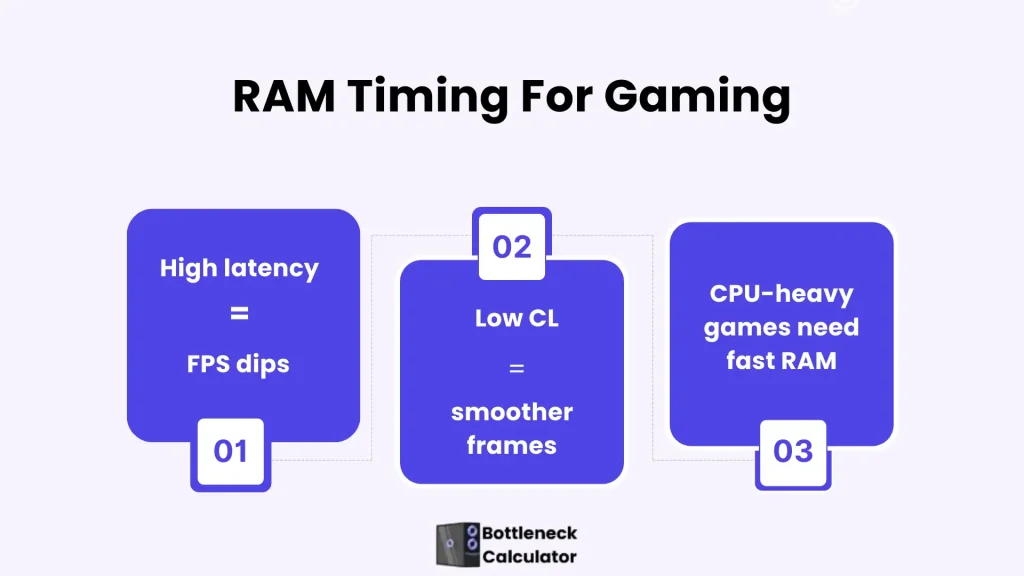
Proper RAM timing ensures memory communicates quickly with your CPU and GPU. Lower CAS latency reduces stutters and smooths frame delivery. Optimized timings improve performance in CPU-heavy games and competitive titles.
DDR4 and DDR5 manage speed and latency differently. Understanding these differences helps maximize FPS and frame stability. Correctly balanced memory ensures smoother gameplay without overspending on unnecessary upgrades.
RAM timing in simple gaming terms
RAM timing is how fast your memory responds to commands. Faster timings reduce delays and make games smoother. Proper timing improves FPS and frame consistency.
H3: Role of CAS latency (CL)CAS latency
(CL) shows how many clock cycles memory takes to respond. Lower CL means quicker data access and less stutter. This affects FPS, especially in CPU-heavy games.
Why gamers should understand timing, not just MHz
High MHz alone doesn’t guarantee better gaming performance. Timing and latency control real-world speed between CPU and RAM. Gamers with optimized timings get smoother gameplay without overspending.
H3 (FAQ/Reddit): What exactly is CAS latency, and why does it matter?
CAS latency measures memory response speed in cycles. Lower CL gives faster data delivery to the CPU. It matters most in games that need quick memory access.
H3 (FAQ/Reddit): How do memory timings affect gaming FPS?
Memory timings control how quickly RAM sends data, and RAM timing for gaming directly impacts real-time performance. Tight timings reduce stutters and improve frame rates in gaming sessions. Faster memory helps both competitive and high-resolution games.
H3 (FAQ/Reddit): RAM frequency vs latency – which is more important for gaming?
High frequency improves bandwidth but doesn’t always boost FPS. Low latency improves frame consistency and smoothness. The best gaming setups balance speed and timing.
H2: RAM Speed vs Latency — How It Really Affects FPS
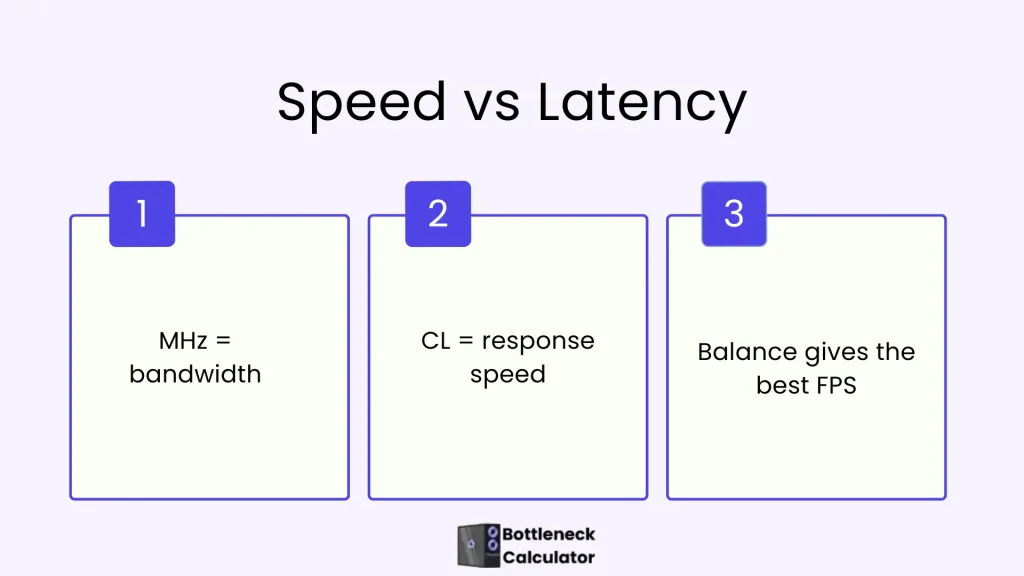
RAM speed (MHz) controls how much data memory can transfer per second, and RAM timing for gaming helps determine how efficiently that data is delivered during gameplay. Latency measures how quickly each request is processed. Both affect FPS, but latency often has a bigger impact in CPU-heavy games.
High frequency increases bandwidth but doesn’t always improve frame rates. Low latency ensures smoother gameplay and fewer stutters, which is why RAM timing for gaming matters more than just higher MHz. Gamers often ignore timing and focus only on MHz, which wastes potential performance.
Dual-channel memory improves performance by increasing data flow. DDR4 and DDR5 handle speed and latency differently in real-world gaming. Balancing frequency and timings gives the best FPS for every setup.
H3: Compare speed (MHz/MT/s) vs latency in practical terms
RAM frequency shows how much data memory can move per second. Latency measures how fast each command completes. For gaming, low latency often gives smoother FPS than just high MHz.
Impact on FPS, frame times, and 1% lows
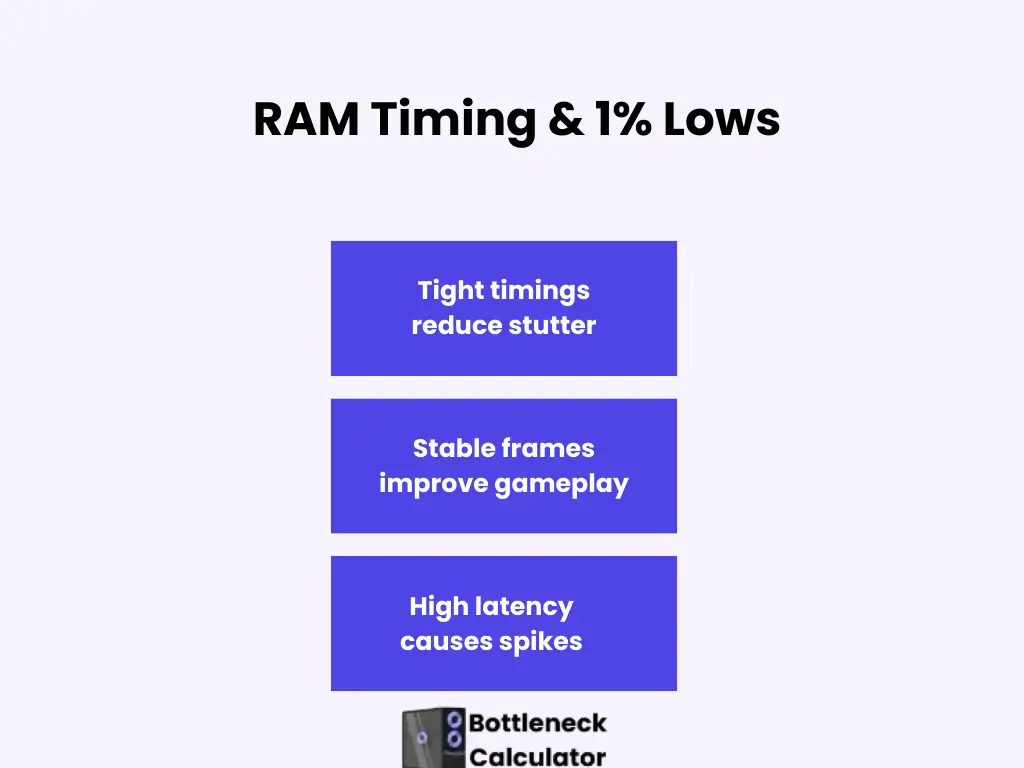
Tighter timings in RAM Timing for Gaming reduce stutters and inconsistent frame times. Faster RAM alone cannot fix FPS dips in RAM Timing for Gaming setups. Balanced speed and latency improve 1% lows and overall gameplay stability.
Break the myth that higher speed is always better
High MHz sounds impressive but doesn’t always boost FPS. Games that rely on CPU or low-latency access benefit more from better timings. Ignoring latency can waste your money on expensive memory.
Will faster RAM always improve my FPS?
Not always — speed alone cannot guarantee higher FPS. Low latency and proper timings often make a bigger difference. The best results come from a balance of frequency and timing.
How much does RAM really matter in 1080p vs 4K gaming?
At 1080p, CPU and RAM speed strongly affect FPS. At 4K, GPU usually limits performance, making RAM speed less critical. Understanding this helps avoid unnecessary upgrades.
H3 (FAQ/Reddit): Is low latency more than high MHz?
Yes, low latency improves frame consistency and reduces stutters in RAM timing for gaming. High MHz helps bandwidth, but cannot replace tight timings in RAM timing for gaming. For real-world gaming, RAM timing for gaming often matters more than frequency.
H2: CAS Latency (CL) Explained Without Technical Jargon
CAS latency (CL) measures how fast RAM timing for gaming responds to CPU requests. Lower CL means memory answers quicker. This improves FPS and reduces stutters in gaming.
High MHz memory with slow CL may not give better performance in RAM timing for gaming setups. Games that rely on CPU or quick memory access benefit more from low latency. Understanding CL helps pick the best RAM timing for gaming in your build.
DDR4 and DDR5 handle latency differently in real-world RAM timing for gaming. Tight timings improve frame consistency and 1% lows. Balancing speed and CL gives smoother gameplay without overspending on RAM timing for gaming.
H3: What CL is (simple analogy)
CAS latency (CL) is like the time it takes for a waiter to bring your food after ordering. Lower CL means the waiter delivers faster. In gaming, this translates to quicker data transfer and smoother FPS.
Effect of lower CL at the same speed
Lower CL improves memory response without changing MHz, which is important in RAM timing for gaming. Games run smoother, and stutters are reduced. CPU-heavy titles benefit the most from tight timings in gaming performance.
When CL really matters for gaming and when it doesn’t
CL matters most in competitive or CPU-focused games. High-resolution or GPU-bound games gain less from low CL. Understanding when latency impacts FPS saves money and boosts real-world performance.
H3 (FAQ/Reddit): How do clock cycle time and CAS latency work together?
Clock cycle time sets the speed of each memory tick. CAS latency counts how many ticks it takes to respond. Combining low CL with short cycles gives faster memory and better frame consistency.
How RAM Timing Impacts Different Gaming Scenarios
RAM timing affects performance differently depending on the game type. CPU-heavy games rely more on low latency for high FPS. GPU-focused or high-resolution games see smaller gains from tight timings.
Competitive esports titles benefit most from optimized CAS latency. Frame consistency and 1% lows improve with proper RAM timing. This gives smoother gameplay in fast-paced matches.
Story-driven or GPU-bound games gain little from lower latency. High frequency still helps with bandwidth-heavy tasks. Knowing which scenario needs timing optimization saves money and boosts real-world performance.
Competitive & CPU-Heavy Games (Esports, high-FPS titles, CPU + RAM interaction)
CPU-heavy games need memory that responds fast. Low CAS latency reduces frame drops and stutters. Tight timings help achieve stable high FPS in esports and competitive titles.
GPU-Heavy & High-Resolution Gaming (1440p / 4K scenarios)
In GPU-bound games, RAM timing matters less for FPS. High resolution shifts load to the GPU. Balanced memory still helps prevent minor stutters and improves frame consistency.
H3 (FAQ/Reddit): Can RAM timing make a difference in competitive FPS games?
Yes, low latency improves reaction times and smooth gameplay. FPS spikes reduce when memory is optimized. Proper RAM timing gives a competitive edge in fast-paced matches.
H3 (FAQ/Reddit): Does RAM speed affect 1% lows and stuttering?
Yes, memory speed and timing affect frame consistency. Tight timings reduce 1% low dips and sudden stutters. Balanced RAM ensures smoother gameplay across all scenarios.
DDR4 vs DDR5 RAM Timing — Gaming Perspective
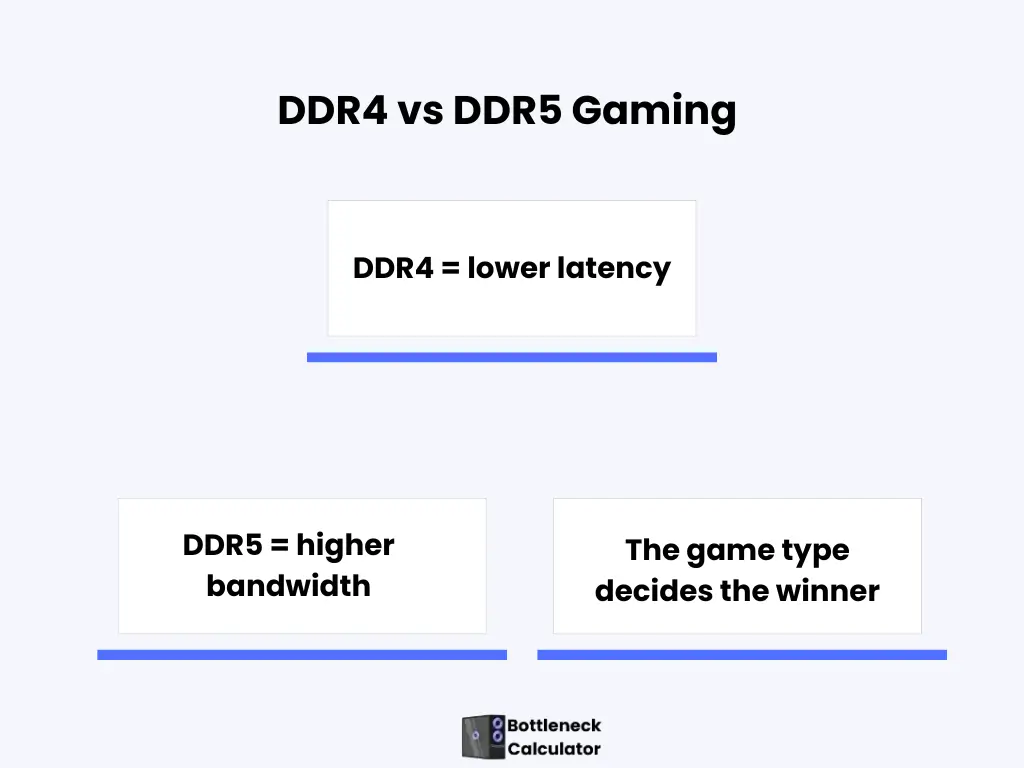
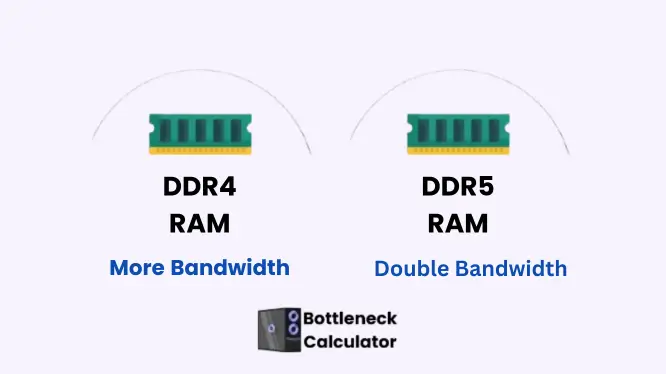
DDR5 offers higher bandwidth but usually higher latency than DDR4. DDR4 with tight timings can outperform DDR5 in CPU-heavy games. Gamers must balance speed and latency in RAM timing for gaming for real-world FPS gains.
DDR5 shines in bandwidth-heavy workloads and future-proof systems. DDR4 remains reliable for most current gaming PCs. Choosing the right RAM depends on the resolution, CPU, and GPU combination.
Many articles ignore the real impact of latency vs bandwidth. Frame consistency and 1% lows often improve more with lower latency DDR4. Understanding DDR4 vs DDR5 differences prevents overspending and boosts gameplay performance.
DDR4 tight timings vs DDR5 bandwidth trade-offs
DDR4 offers lower latency and tighter timings, which boost FPS in CPU-heavy games. DDR5 provides higher bandwidth but sometimes adds small delays. Gamers must pick based on CPU, GPU, and game type.
Practical takeaways for gamers
Competitive gamers often benefit more from DDR4 low-latency RAM. High-resolution and future-proof setups can use DDR5 for better bandwidth. Knowing which RAM fits the game type saves money and improves real-world performance.
H3 (FAQ/Reddit): Is DDR5 better than DDR4 for gaming right now?
DDR5 is not always faster than DDR4 in today’s games. CPU-intensive titles may run smoother with tight DDR4 timings. Choose RAM based on latency, bandwidth, and your gaming setup rather than just the generation.
Can RAM Timing Cause a Bottleneck in Gaming?
RAM timing can limit FPS if it is too high for the CPU. Low CAS latency and proper frequency help the CPU feed the GPU efficiently. Unbalanced memory can hold back strong gaming setups.
Bottlenecks appear in CPU-heavy or esports titles first. High latency can cause stutters, frame drops, and uneven 1% lows. Optimizing RAM timing improves smoothness and reaction times.
Many guides ignore the effect of timing vs capacity. More RAM is not always better than faster, lower-latency modules. Knowing when RAM causes a bottleneck saves money and boosts real-world performance.
Clear definition of RAM bottleneck
A RAM bottleneck happens when memory speed or timing slows down the CPU or GPU. It stops games from reaching full FPS potential. Low-latency RAM helps avoid stutters and frame drops.
H3: CPU–RAM bottleneck relationship
CPU relies on fast RAM to fetch data quickly. If RAM is slow, even strong CPUs underperform. Balanced RAM and CPU ensure smooth gameplay.
H3: Situations where RAM timing limits FPS
Competitive esports games often show RAM timing issues first. High latency causes frame dips and inconsistent 1% lows. Heavy multitasking while gaming can also highlight weak RAM timing.
H3 (FAQ/Reddit): Can my RAM cause a bottleneck for CPU or GPU?
Yes, slow or high-latency RAM can limit both CPU and GPU performance. Gaming FPS may drop despite strong hardware. Correct timing and speed prevent this problem.
H3 (FAQ/Reddit): How to know if RAM is holding back my gaming performance?
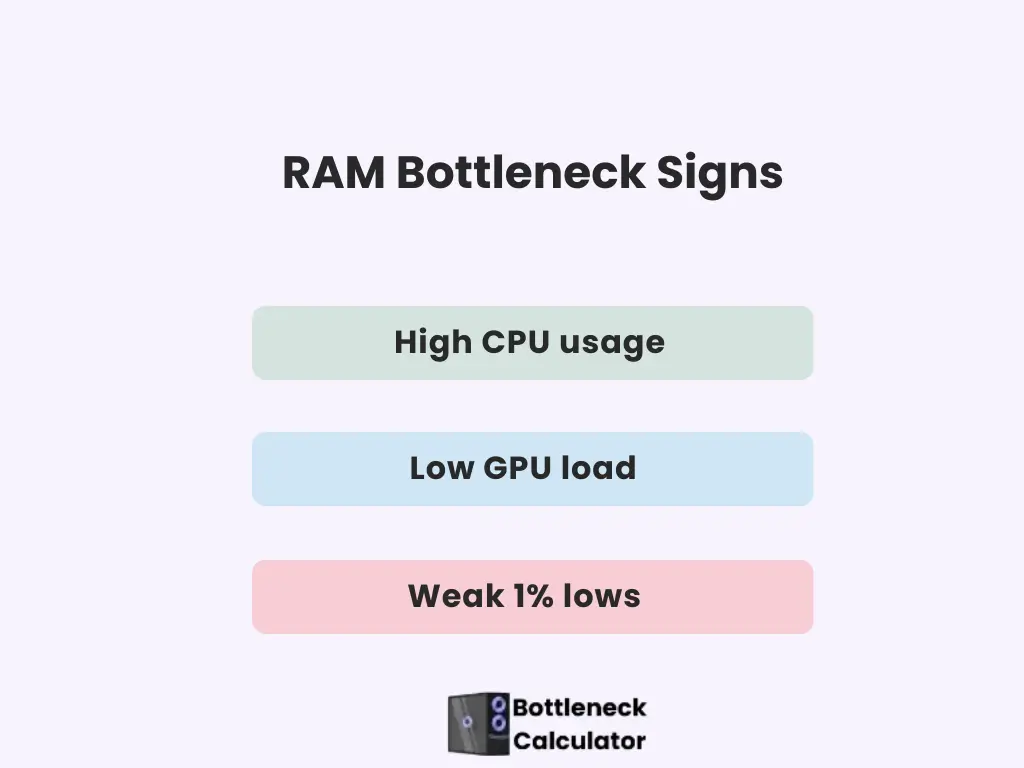
Monitor frame rates, 1% lows, and stuttering patterns. Compare FPS with RAM speed upgrades if possible. Low GPU usage with high CPU usage often signals RAM limits.
H3 (FAQ/Reddit): Can too much RAM actually reduce performance?
Excess RAM rarely boosts FPS beyond what the system needs. Some older systems may face inefficiencies with very large modules. Optimal RAM size and speed deliver better results than sheer capacity.
H2: Signs Your RAM Timing Is Holding Back Performance
Low FPS despite a strong GPU can signal slow RAM timing. Stuttering and inconsistent frame times appear in CPU-heavy games. Monitoring 1% lows shows hidden memory delays.
High CPU usage with low GPU load often points to memory issues. Game freezes or micro-stutters happen when RAM cannot keep up. Upgrading to lower-latency RAM usually fixes these bottlenecks.
Long load times in open-world or multitasking games may indicate timing problems. FPS spikes that drop under 60 happen even with high-end hardware. Checking RAM speed and CAS latency helps identify performance gaps.
H3: Low GPU usage despite a strong GPU
A strong GPU may not reach full load if the RAM is slow. Low RAM speed delays data flow to the GPU. Upgrading to faster, low-latency memory improves performance.
H3: Inconsistent FPS and stuttering
Stutters appear when RAM timing is too high. FPS drops are most noticeable in CPU-heavy or competitive games. Proper RAM configuration keeps gameplay smooth.
H3: High CPU usage patterns
High CPU usage with low GPU activity signals a memory bottleneck. Slow RAM forces the CPU to wait on data. Optimized CAS latency improves overall system efficiency.
H3 (FAQ/Reddit): How do I check my RAM timings and optimize them?
Check timings in BIOS or with system tools. Enable XMP or EXPO profiles for correct speed and latency. Lowering CAS latency can improve FPS in demanding games.
Best RAM Timing Balance for Gaming Builds
Budget gaming PCs benefit from DDR4 modules with moderate speed and low CAS latency. Too high frequency is costly but offers minimal FPS gains. Choosing the right balance improves game performance without overspending.
Mid-range builds perform best with faster RAM and tighter timings. Dual-channel setups increase bandwidth and reduce latency. This combination helps maintain consistent FPS in modern titles.
High-end and enthusiast systems need DDR5 with optimized speed and low latency. Overclocking RAM carefully boosts both FPS and 1% lows. Proper timing ensures top-tier gaming performance without bottlenecks.
H3: Budget Gaming PCs
Budget builds perform best with DDR4 RAM at moderate speeds. Low CAS latency improves FPS in esports and lightweight games. Avoid overspending on extreme frequencies that add little real benefit.
H3: Mid-Range Gaming Builds
Mid-range systems benefit from faster RAM and dual-channel setups. Tighter timings reduce stutter in modern titles. Proper RAM choice balances cost and performance effectively.
H3: High-End & Enthusiast Systems
High-end PCs shine with DDR5 modules and optimized timings. Overclocking carefully improves FPS and frame consistency. Correct RAM ensures CPU and GPU reach full potential.
H3 (FAQ/Reddit): Should I upgrade from 16GB to 32GB for gaming?
16GB suffices for most games at 1080p. 32GB helps with heavy multitasking and high-resolution gaming. Upgrade only if FPS or stuttering indicate memory limits.
H3 (FAQ/Reddit): Does dual-channel RAM really make a difference?
Yes, dual-channel RAM doubles memory bandwidth. Games with high CPU demand run smoother. Single-channel RAM can bottleneck both FPS and frame times.
When RAM Timing Does NOT Matter
RAM timing has little impact on GPU-bound games. High-end graphics cards handle most of the load, so RAM speed becomes secondary. Prioritize GPU upgrades before obsessing over RAM timing.
Casual or story-driven games rarely need ultra-low latency RAM. FPS gains are minimal at 1080p or medium settings. Gamers save money by avoiding unnecessary RAM overclocking.
Extreme timing tweaks can sometimes reduce system stability. Over-optimizing RAM rarely boosts real-world performance. Balanced PC builds always outperform overly tuned memory.
H3: GPU-bound scenarios
Games that rely mostly on GPU do not benefit much from faster RAM. FPS is limited by graphics card performance. Focus upgrades on GPU before adjusting RAM timing.
H3: Casual or story-driven games
Story-based or low-demand games rarely show FPS gains from tight RAM timings. Standard DDR4 or DDR5 modules are sufficient. Gamers save money by avoiding unnecessary high-speed RAM.
H3: Risks of over-optimizing
Overclocking RAM or lowering timings too much can cause crashes. Stability is more important than small FPS gains. Balanced settings ensure smooth gameplay without extra cost.
H2: How to Check If RAM Timing Is a Bottleneck
Start by checking FPS, frame times, and CPU usage during gameplay. Low GPU usage with high CPU load often signals a memory issue. RAM timing can limit performance even with a strong GPU.
Compare gaming results before and after enabling XMP or EXPO. Smoother frame times and better 1% lows indicate improved memory latency. This method isolates RAM timing from other hardware limits.
System balance matters more than raw numbers. A balanced CPU, GPU, and RAM setup avoids hidden bottlenecks. Simple testing saves money and prevents unnecessary upgrades.
H3: System balance concept
Gaming performance depends on CPU, GPU, and RAM working together. One weak part can slow the whole system. Balanced builds always deliver smoother FPS and better frame times.
H3: How to isolate RAM timing from other components
Lower graphic settings to reduce GPU load first. Then compare FPS before and after changing RAM timings. This method shows if memory latency affects performance.
H3: Soft calculator mention
Online bottleneck calculators help check system balance quickly. They show how CPU, GPU, and RAM interact in games. Use them as a guide, not a final decision.
H3 (FAQ/Reddit): Should I enable XMP or EXPO for better performance?
Yes, XMP or EXPO unlocks rated RAM speed and timings. Games run smoother with proper memory profiles enabled. Most systems gain performance without extra risk.
H3 (FAQ/Reddit): Will overclocking RAM improve FPS?
RAM overclocking can improve FPS in CPU-heavy games. Gains are small but help reduce stuttering. Stability matters more than extreme numbers.
H3 (FAQ/Reddit): Is my CPU limiting my RAM speed?
Yes, the CPU memory controller sets RAM limits. Older CPUs may not handle high RAM speeds well. Faster RAM helps only when the CPU supports it.
H2: Practical Upgrade Advice Before Spending Money
Always identify the real bottleneck before upgrading hardware. Many FPS issues come from poor system balance, not weak parts. Smart testing saves money and time.
RAM timing upgrades help only in CPU-heavy gaming scenarios. GPU-bound games see little benefit from faster memory. Spend first where performance gains are clear.
Enable proper RAM profiles before buying new parts. Simple tweaks often fix stuttering and low FPS. Informed upgrades always outperform random spending.
H3: Light mention of BIOS settings
BIOS settings control RAM speed and timings directly. Simple changes can unlock better gaming performance. Avoid advanced tweaks unless you understand system stability.
H3: Role of XMP / EXPO
XMP and EXPO apply tested RAM profiles automatically. They improve RAM speed and latency safely. Most gaming PCs gain smoother FPS with one click.
H3: Prevent unnecessary upgrades
Many FPS problems come from misconfigured RAM, not weak hardware. Fix settings before buying new parts. Smart tuning saves money and boosts performance.
H2 Key Takeaways for Gamers
RAM speed and timing both affect gaming performance. Low latency improves smoothness in CPU-heavy games. MHz alone never tells the full story.
RAM timing for gaming does not boost FPS in every setup. GPU-bound games see minimal gains from faster memory. System balance always matters more than specs.
Correct settings often outperform hardware upgrades. Enable XMP or EXPO before spending money. Smart tuning delivers better FPS and stability.
H3: Both speed and timing are important
RAM speed controls data flow, and timing controls response speed. Both work together to improve gaming performance. Ignoring either can limit FPS in CPU-heavy games.
H3: RAM timing affects FPS, but not for every system
Tight RAM timing for gaming helps systems that depend on CPU performance. GPU-bound setups see little FPS change. Results always depend on the overall system balance.
H3: Balanced PC builds always perform better
Balanced PCs avoid CPU and RAM bottlenecks. Games run smoother with stable frame times. Smart part selection beats chasing high numbers.
FAQ’s
Conclusion
RAM timing for gaming matters more than most gamers think. Balanced RAM speed, low CAS latency (CL), and proper frequency improve FPS, 1% lows, and frame stability in CPU-heavy games.
Smart tuning, dual-channel setup, and correct XMP or EXPO settings deliver smoother gameplay without wasting money on unnecessary upgrades.