
Free PC Bottleneck Calculator: Check CPU & GPU Performance
🔹Use our trusted PC bottleneck calculator to check how well your CPU and GPU are working in just 30 seconds and boost your gaming speed quickly with real results.
Select your CPU and GPU to calculate potential bottlenecks in your system
0-10%: Excellent balance, optimal performance
10-20%: Good balance, minor bottleneck
20-30%: Noticeable bottleneck, upgrade recommended
30%+: Significant bottleneck, upgrade needed
Press Ctrl + Shift + Esc to open Task Manager, then go to the Performance tab. There you'll find your CPU, RAM, and GPU details.
To check screen resolution: Right-click desktop → Display settings.
Note: Learn how to use the bottleneck calculator.
Visual Guide to use our CPU and GPU calculator.
Trusted by
 AMD RYZEN
AMD
 nvidia
intel
Introduction
Many PC enthusiasts and gamers face the problem of performance slowdown due to hardware compatibility. Rendering, stuttering, and lagging are the major issues encountered while playing demanding games and performing multiple complex tasks, such as video editing. These issues cause frustration for users and affect their performance.
To resolve these issues, we designed this performance calculator to identify the limitations of your PC. Simply enter the specifications of your hardware—CPU, GPU, RAM, and storage—into the desired boxes, and our PC performance estimator will quickly identify any potential bottlenecks.
Use our trusted PC bottleneck tool now to get instant insights into your system’s performance and how to optimize it for a smoother experience. Our PC bottleneck checker helps you:
What Is A PC Bottleneck Tool, And Will it find a Bottleneck?
It is a free and reliable online tool to elevate the performance balance between CPU and GPU. It assists users in detecting potential bottlenecks in their computers and improving their PC performance.
This tool uses an effective approach to check your hardware performance and provides valuable insights into any system limitations.”
Bottleneck identifier compares performance data from thousands of tests, as well as how your CPU and GPU perform in games and apps. This bottleneck tester also acts as a CPU and GPU bottleneck checker to highlight components that perform slowly while others.
From the above discussion, it is clear that our free and trustworthy tool will find your PC bottleneck by testing CPU and GPU performance in realistic work, such as gaming.
How to Use Our Bottleneck Calculator For Gaming PC?
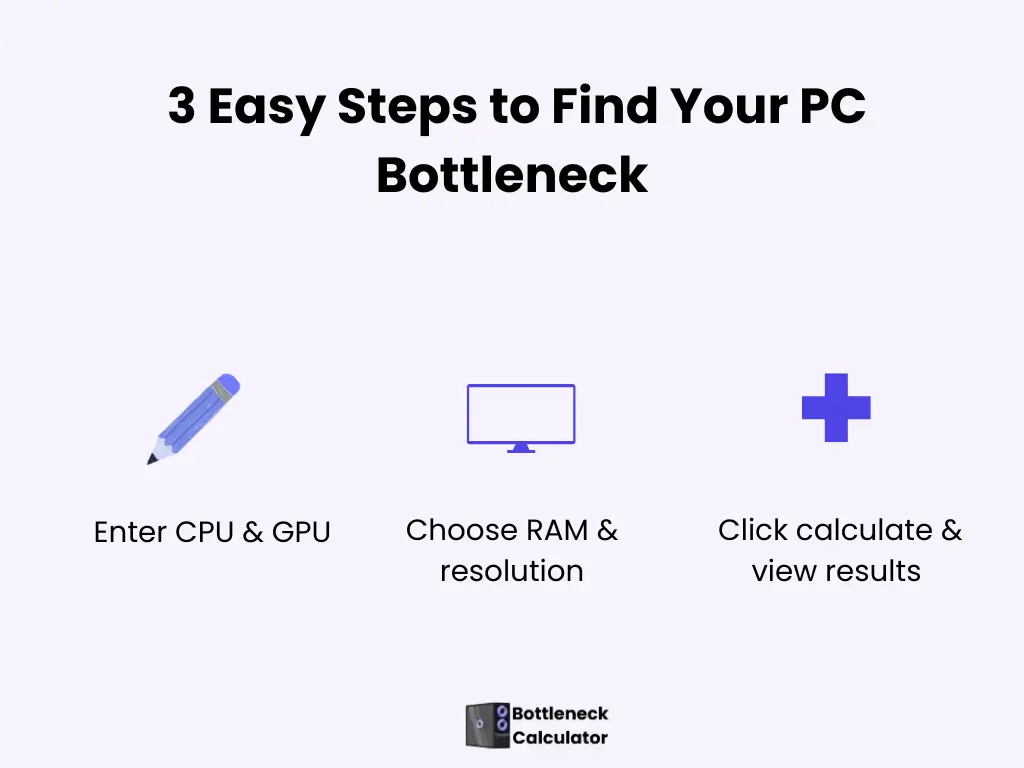
Follow these simple steps to get an accurate result from our bottleneck helper:
How Do You Interpret Bottleneck Calculator Results?
We break down the bottleneck tool result into 3 steps:
Percentage
The percentage represents how much the slower speed component affects the performance of the faster speed components.
So, updating your CPU and GPU is essential to maintain your system and run background applications smoothly.
Analyzing The Performance
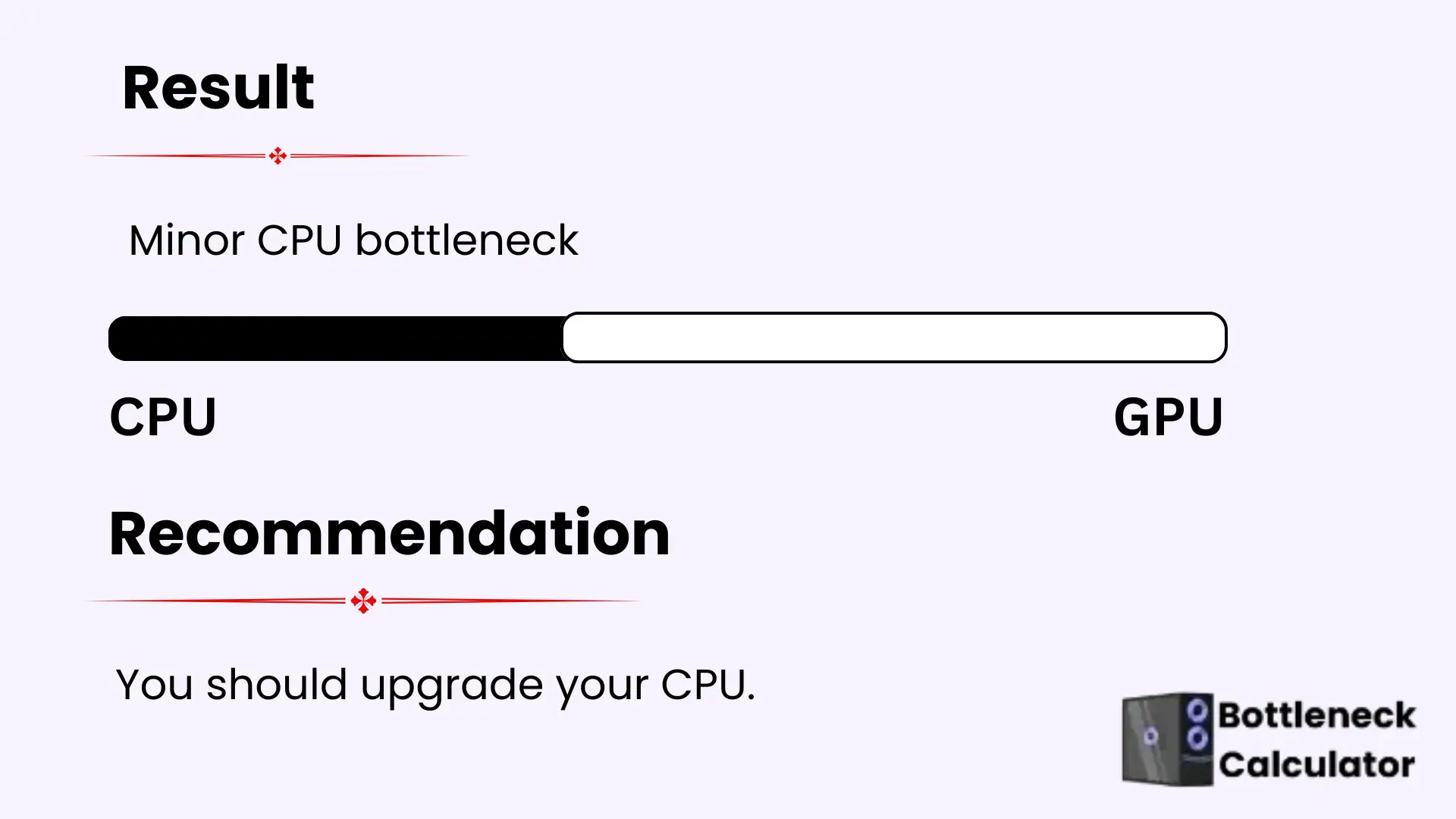
If the tool shows the CPU Bottleneck, improving the processor can create a balance in your system. When the GPU bottleneck shows a high score, it means you need to improve your graphics card.
Future Software Requirements
Possibly, your PC performs well with a minor bottleneck, but in the future, new apps and games could demand a more powerful system. If you update it in time, it will run fast, and you will be prepared for future updates.
How Bottleneck Calculator Maximizes Your PC’s Performance?
These key advantages help you to upgrade your PC performance:
User-Friendly Interface
Our Bottleneck detector has a user-friendly interface for beginners and tech users.
30 sec Compatibility Check
The bottleneck identifier checks the CPU and GPU compatibility to boost game performance.
Data Integration of Real Users
Nearly 600,000 tests are configured in our community database.
Dynamic Adjustment For Storage
Our analyzer also checks RAM Speed and capacity, and storage devices (HDD and SSD) to give an accurate result of your PC performance.
Performance Score in Percentage
Our trusted tool gives you a simple, clear percentage score from 0 to 100. It helps you understand how to improve CPU and GPU compatibility using reliable data.
Future Recommendation
This tool also gives useful future support to eliminate the bottleneck from your hardware components.
Our bottleneck calculator supports the latest CPU and GPU models, Software like Intel’s 4th generation, AMD Zen 5, and RTX50 series. Furthermore, more optimization of Windows 11 also helps to remove the bottleneck.
What is a PC Bottleneck And its Causes?
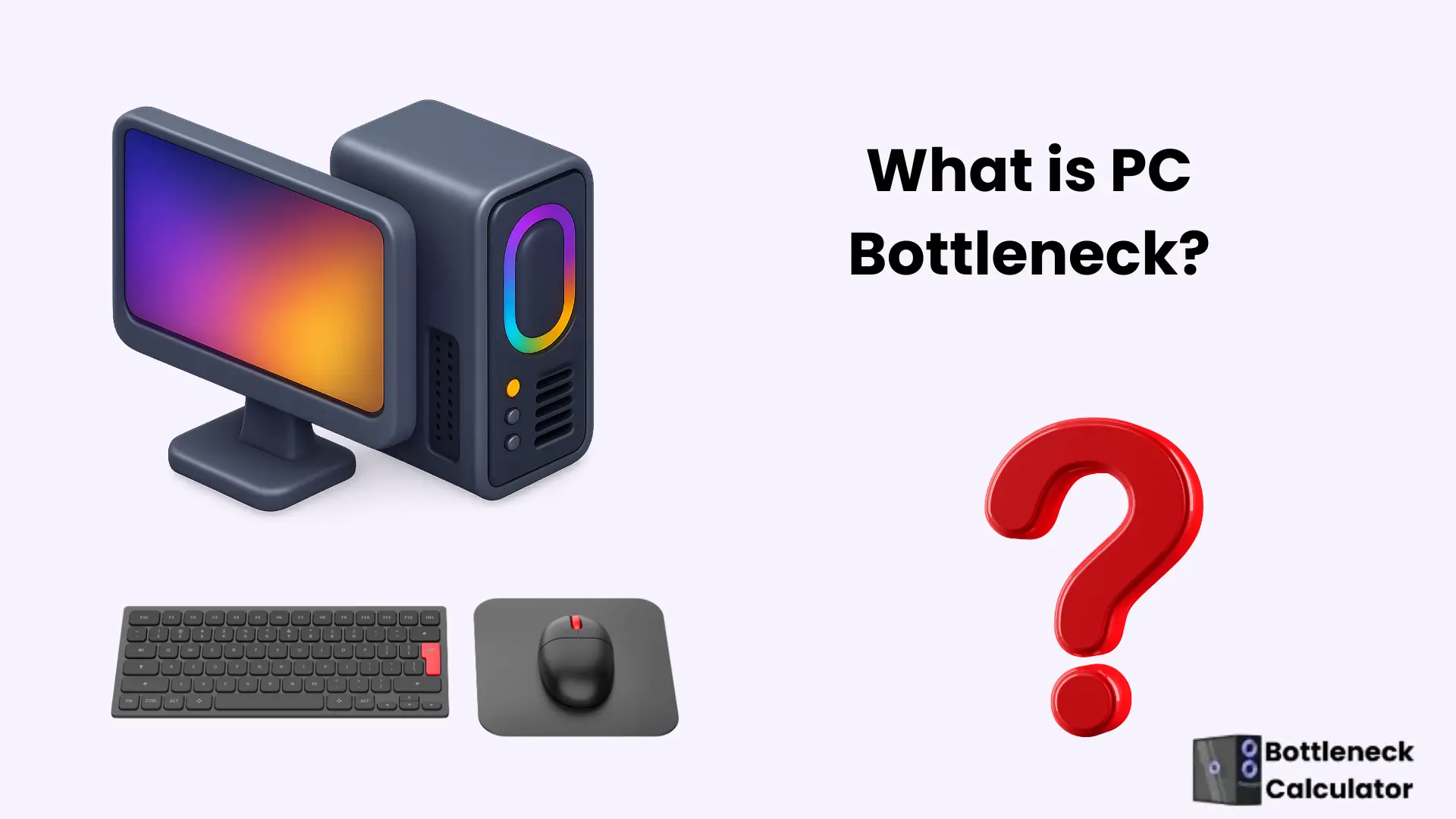
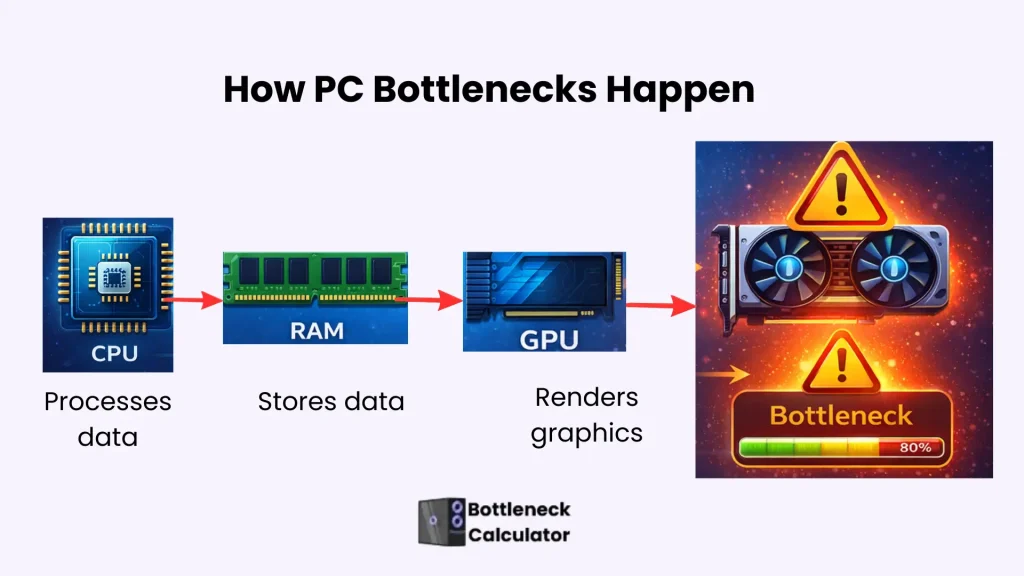
PC bottleneck happens when a component (CPU or GPU) in your system is too weak and unable to work according to the needs of other parts, which impacts the overall PC performance and creates a bottleneck. Major causes of Pc bottleneck are:
Some other causes besides the GPU and CPU are:
CPU VS GPU Bottleneck: What’s the Difference?
The CPU and GPU are the hardware components that can create a bottleneck, affecting the overall computer system’s performance. CPU and GPU bottlenecks are often related to gamers and intensive programs because they interfere with the performance of certain parts.
Let’s stay with us to find out the difference between CPU and GPU bottlenecks and their impact on PC performance.
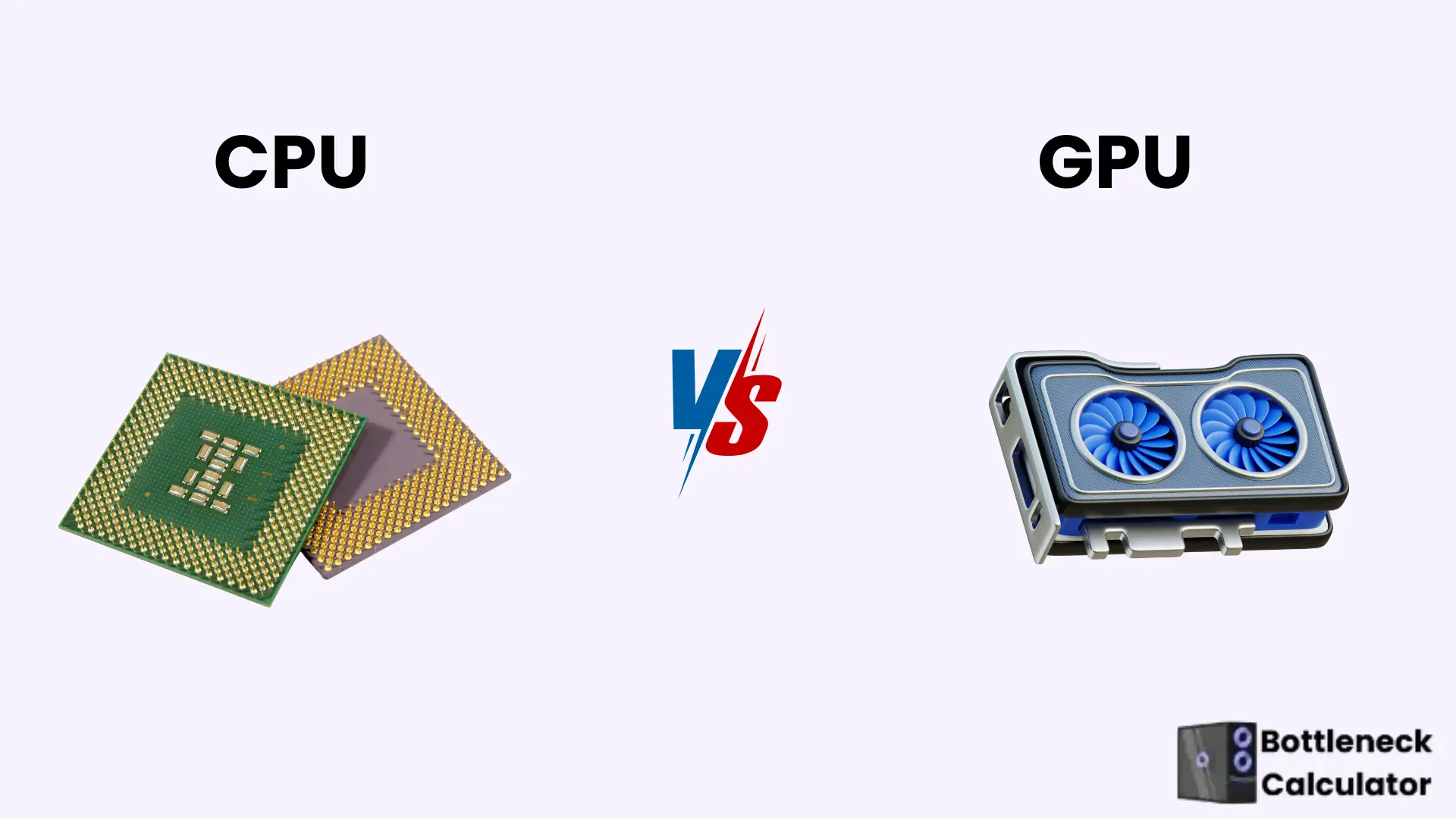
CPU Bottleneck
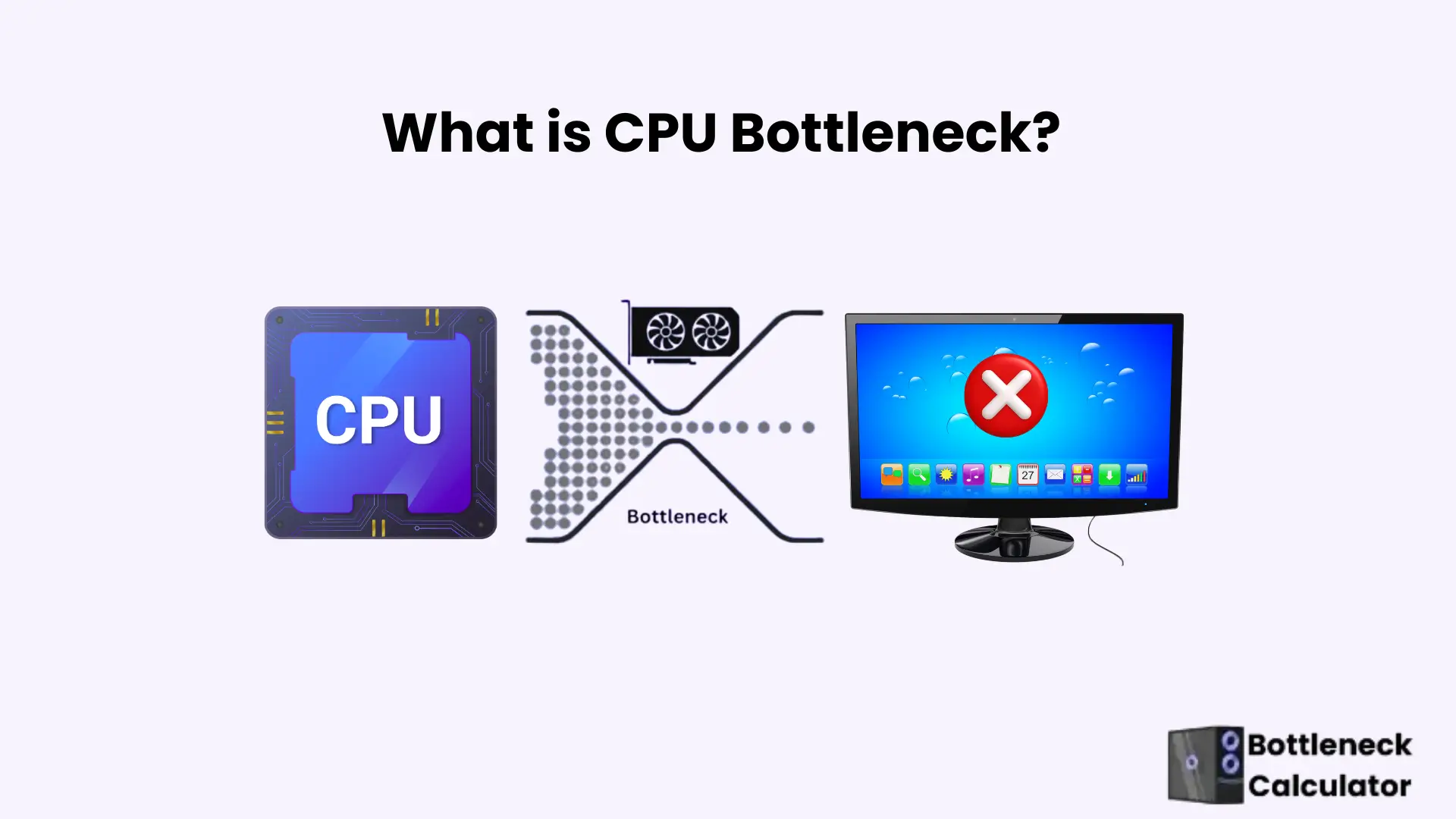
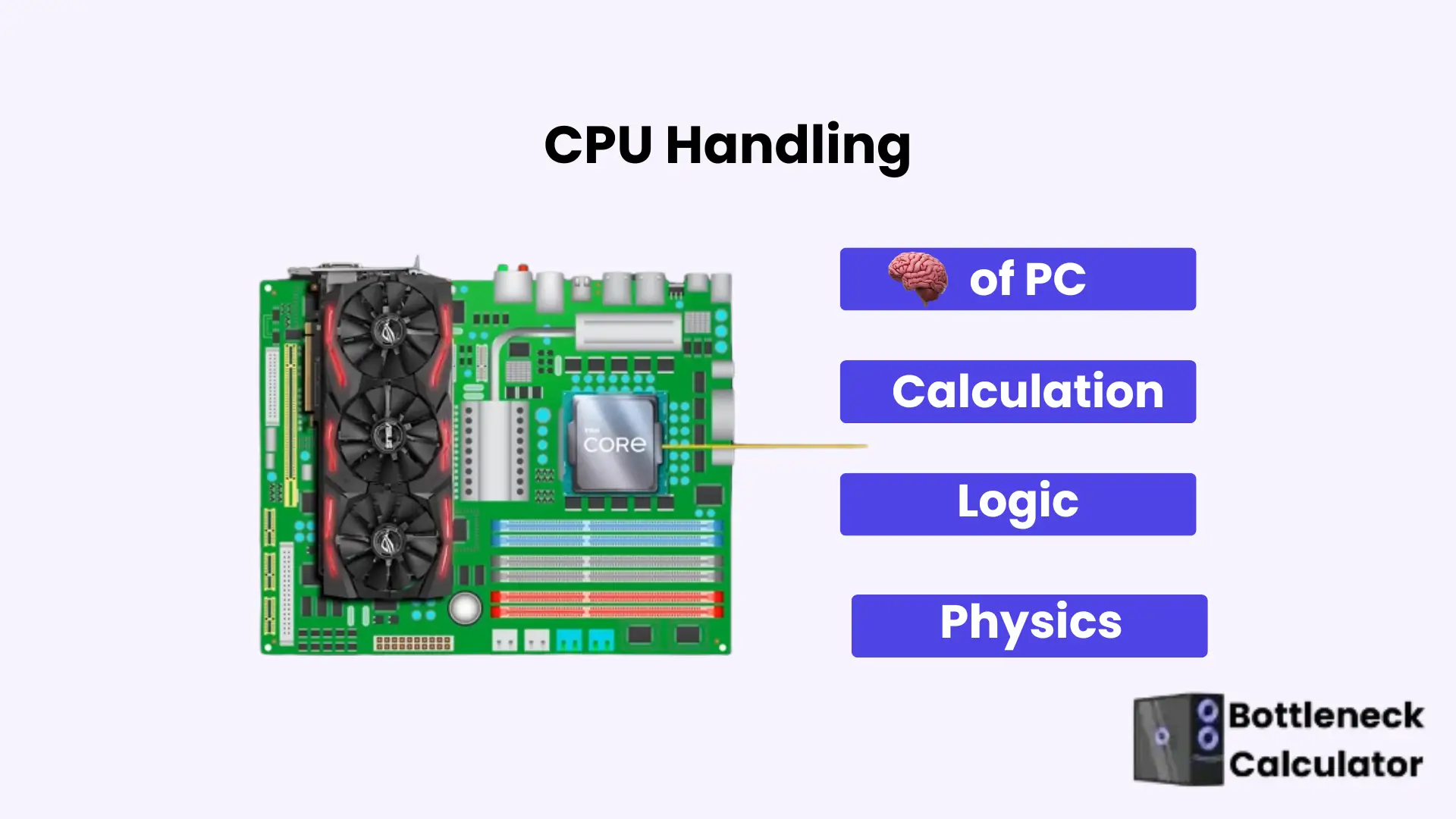
If your GPU is powerful and your CPU has some weakness, your CPU’s performance doesn’t match the graphics card, and you are not able to achieve the desired performance, especially while playing games, it creates a CPU bottleneck.
CPU Bottleneck Signs
Below are symptoms that help users know how the CPU is bottlenecked:
Major Factors Of CPU Bottleneck
Significant causes for CPU bottleneck are below:
How To Address CPU Bottleneck?
To remove the CPU bottleneck, follow our steps:
- Upgrading to a new, powerful, multicore, and modern processor can improve performance.
- Manage a proper cooling system for the processor.
- The background application should be closed, as it frees the CPU resources.
- Declining the CPU-intensive settings is helpful to fix the CPU bottleneck.
How Does The CPU Bottleneck The GPU?
If your CPU bottleneck is unable to process and send the data according to the requirements of the GPU, this slower process prevents the GPU from working at its proper capacity and speed. It also slows down your performance while your GPU can work better.
What Is GPU Bottleneck
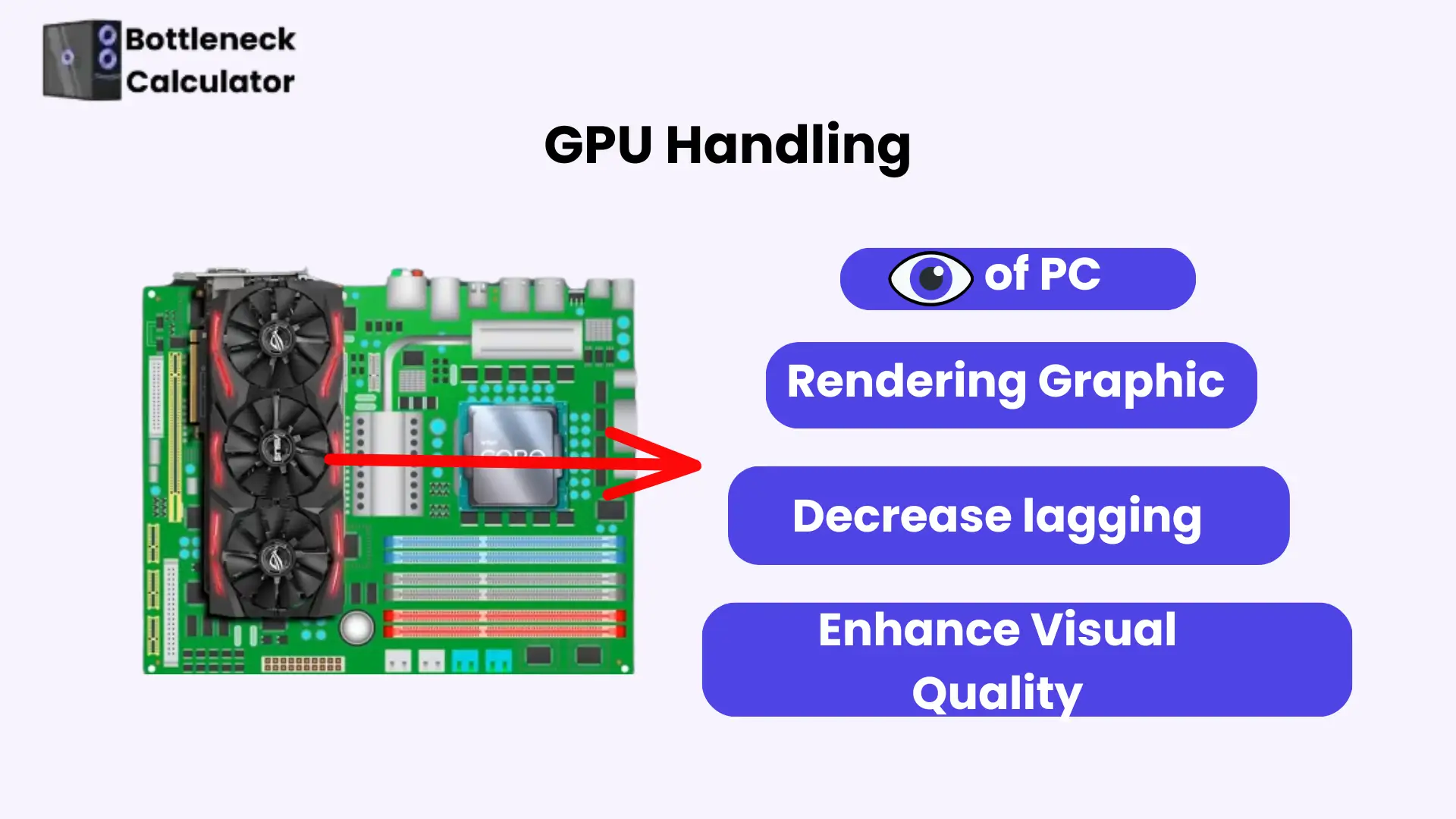
If your Central processing unit works faster than the GPU, it means the GPU is bottlenecked and not rendering the graphical data as the CPU needs.
GPU Bottleneck Signs
Here are the symptoms of a GPU Bottleneck to assist users in knowing how the GPU is bottlenecked:
Factors Contributing To GPU (Video Card ) Bottleneck
Some common factors of the GPU bottleneck are discussed below:
How To Address GPU Bottleneck
To solve the GPU Bottleneck, follow these steps strictly:
- The latest and most powerful graphics cards can enhance performance.
- Decreasing the settings, quality, and texture to reduce the GPU bottleneck.
- Improve the GPU cooling system to avoid thermal throttling.
How Does The GPU Bottleneck The CPU In A Gaming PC?
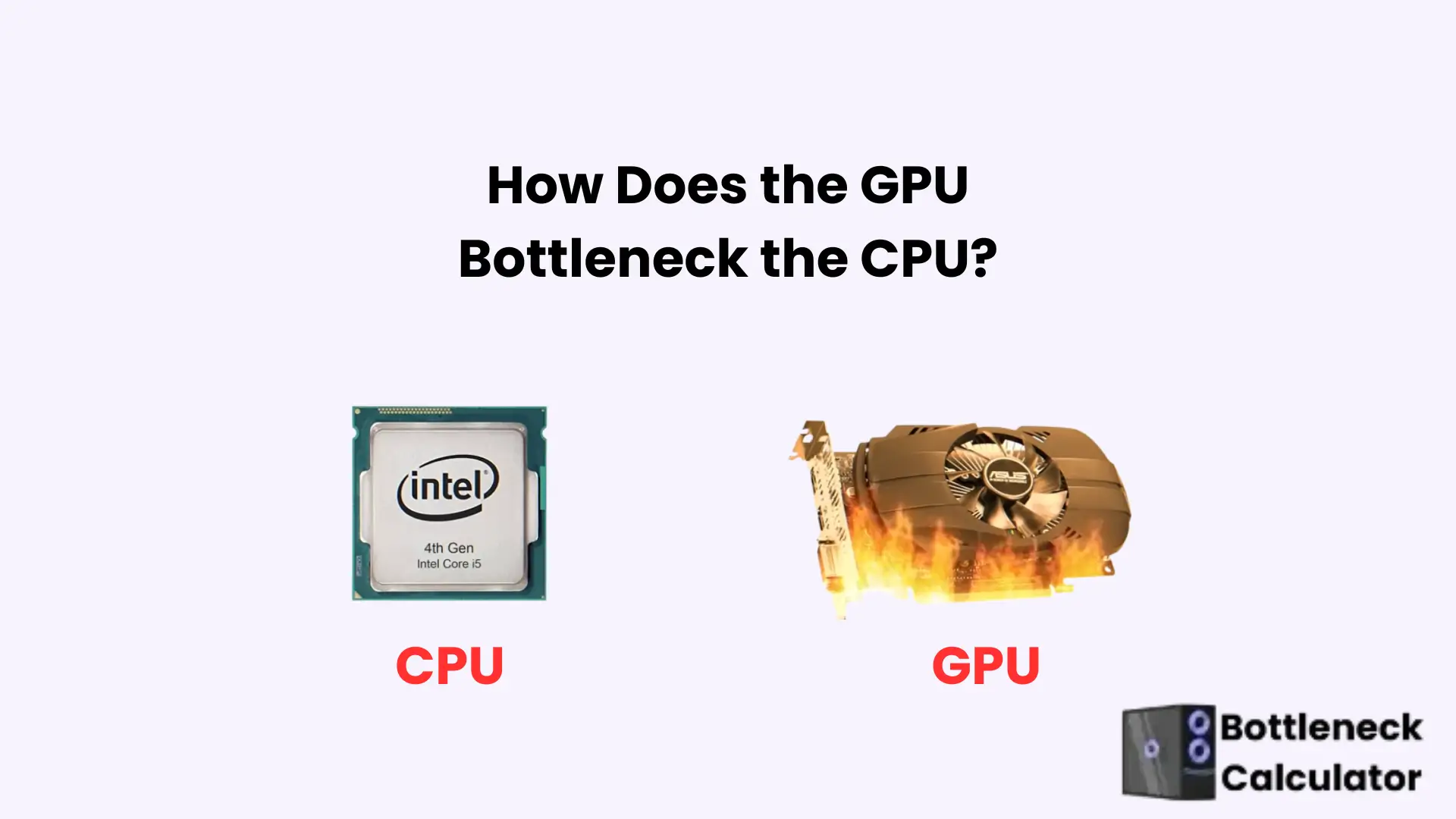
If your graphics card is unable to render frames as fast as your CPU can process data, the CPU ends up waiting until the graphics card completes its task. It creates a graphics card bottleneck for the CPU.
How GPU And CPU Bottlenecks Impact Your Gaming Performance?
SSD Bottleneck Calculator
A bottleneck occurs when one component of your PC, such as the storage drive (SSD), limits the overall system performance. In the case of SSDs, slower storage speeds can cause delays in data processing, ultimately affecting gaming, video editing, and overall system responsiveness.
While traditional hard drives (HDDs) are slower than SSDs, even SSDs can experience bottlenecks under certain conditions. If your system uses a SATA-based SSD, upgrading to a faster NVMe SSD can significantly improve data transfer rates and reduce latency.
But how do you know if an SSD is holding back your performance? This is where an SSD bottleneck assistant comes into play.
How SSDs Solve Bottlenecking Issues with Slower Storage
SSD bottlenecking happens when your SSD is not fast enough to keep up with other powerful components, like your CPU or GPU. This issue becomes especially noticeable during tasks like gaming, rendering, or running multiple apps simultaneously.
Here’s how SSDs impact bottlenecks:
Solutions for SSD Bottlenecks
To prevent SSD bottlenecks and upgrade performance:
Benchmark Results: Real-World Impact
Here’s how NVMe SSDs outperform SATA SSDs in real-world tasks:
| Task | SATA SSD | NVMe SSD |
| Boot Time | 20-30 sec | 10-15 sec |
| Game Load Time | 35-50 sec | 10-15 sec |
| File Transfer | 200-400 MB/s | 1500-3500 MB/s |
| Video Rendering | 45-60 min | 25-35 min |
Use our free tool to check if your SSD is causing a bottleneck. Simply enter your system specs (CPU, GPU, SSD), and receive insights and upgrade recommendations.
Improve Your SSD: Tips for Performance
- Enable TRIM: Ensures efficient use of unused space and improves lifespan.
- Upgrade Storage: If your SSD is nearing full capacity, consider upgrading for improved performance.
Laptop Bottleneck Calculator / Mobile Performance
Laptops and mobile devices are often constrained by limited resources like CPU power, RAM, and thermal management. These bottlenecks can significantly impact performance, especially when running demanding tasks such as gaming or video editing.
Our Laptop Bottleneck Calculator helps you identify these issues and offers tailored recommendations to enhance your device’s performance, ensuring smoother operations.
How Do You Find the PC Bottleneck in Your System?
Use our online bottleneck calculator to find the PC bottleneck and analyze CPU and GPU performance. Use the task manager and MSI Afterburner to monitor the CPU and GPU current usage.
Performance Monitoring With Task Manager
- Quick Performance Check with Task Manager.
- Type Ctrl+Shift+Esc to open the task manager.
- Analyze real-time usage of CPU and GPU in the performance tab.
- Find the Hungry app in the process tab.
- Examine the performance while playing the game.
Advanced And Unique Performance Analysis
- Install the free MSI Afterburner.
- Set up your performance screen.
- Trace FPS and recent components usage in real time.
- Establish your performance profile for various games.
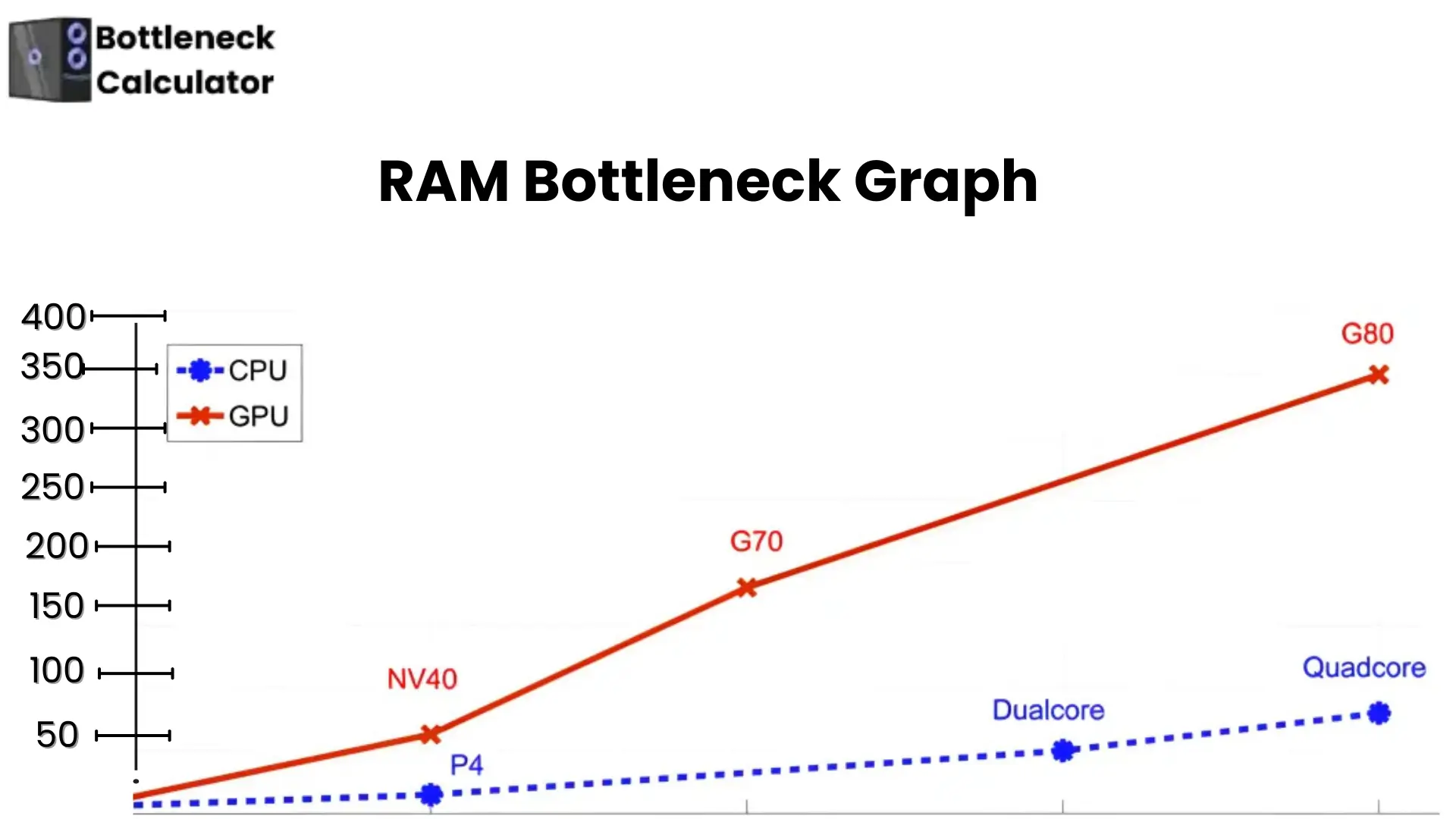
Does RAM Cause a Bottleneck?
RAM speed also affects the bottleneck score. The right type of RAM — whether DDR4 or DDR5 — can make a noticeable difference in your system’s performance, based on what your CPU and motherboard support. Suppose you have an excellent quality of CPU and GPU, but with only 8 GB of RAM, then you have to face the problem of stuttering and lagging.
Reason: 8GB RAM is not enough to download heavy game files or to run background apps smoothly.
Solution:16GB RAM is sufficient for playing well and also running background apps smoothly.
Real-Life Examples – Increasing RAM Speed and Capacity
Upgrading your RAM is one of the quickest ways to eliminate bottlenecks, especially for gaming and multitasking. Adding more RAM or upgrading to faster modules reduces lag, speeds up load times, and improves overall system efficiency.
Real-life benchmarks show that increasing RAM from 8GB to 16GB can cut game load times by up to 30%, resulting in a more fluid experience.
So, updating your CPU and GPU is essential to maintain your system and run background applications smoothly.
Best Practice For Reducing The Impact Of PC Bottlenecks(A Real-World Example)
Let’s explore some real examples of reducing the PC Bottleneck.
Improving The CPU For High-End GPU
You have a new and powerful graphics card like NVIDIA RTX 3080, but your CPU is an old version like Intel Core i5-9400F; the computer works very slowly while playing games or multitasking because of the outdated CPU.
Reason: The latest and most powerful GPU is not suitable with an old processor (CPU).
Solution: Use a new processor like Intel Core i9-10900K. The result is that your gameplay runs smoothly without any pause.
Improving Cooling Power to Enhance Performance
If you have a good PC, you can still face the problem of a slow system during video editing or playing games. When you play a game, your processor produces heat, and if you do not have a proper system of cooling, it will slow down your system.
Solution: A Proper cooling system should be managed for the PC. Your PC runs smoothly, and your performance will improve.
CPU and GPU Overclocking
GPU and CPU overclocking are helpful techniques to reduce the PC bottlenecks. In this Stragedy, you can easily overclock the CPU and GPU to get better gaming performance. However, you should follow each step carefully, because the results are based on the component’s specifications and their cooling power; otherwise, it may create bottlenecks.
Support For The Latest Software
This tool provides a clear and valuable suggestion to remove the bottleneck. If results show that your central processing unit is creating the problem, apply its suggestions and save your PC from a bottleneck.
Multi-Component And Multi-Task Bottleneck Analysis
Not only does CPU and GPU performance matter, but RAM and storage performance are counted here. A healthy relationship between these components is essential to reduce the PC bottleneck.
Effects Of Various Resolutions
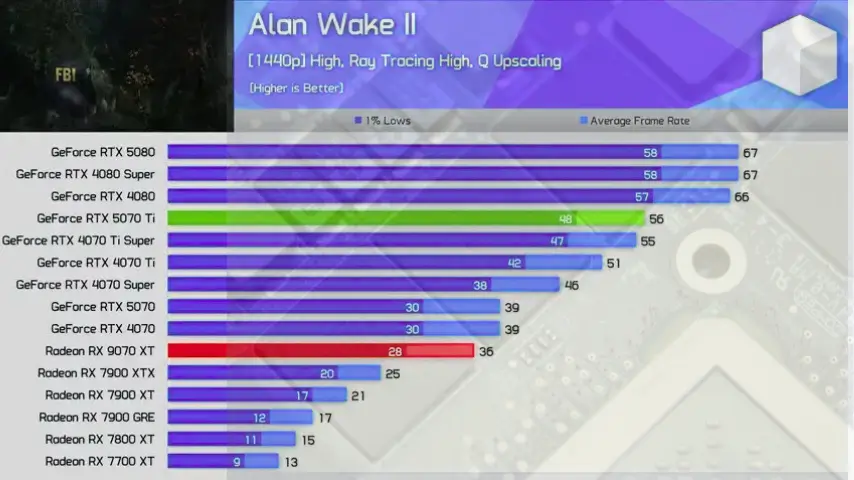
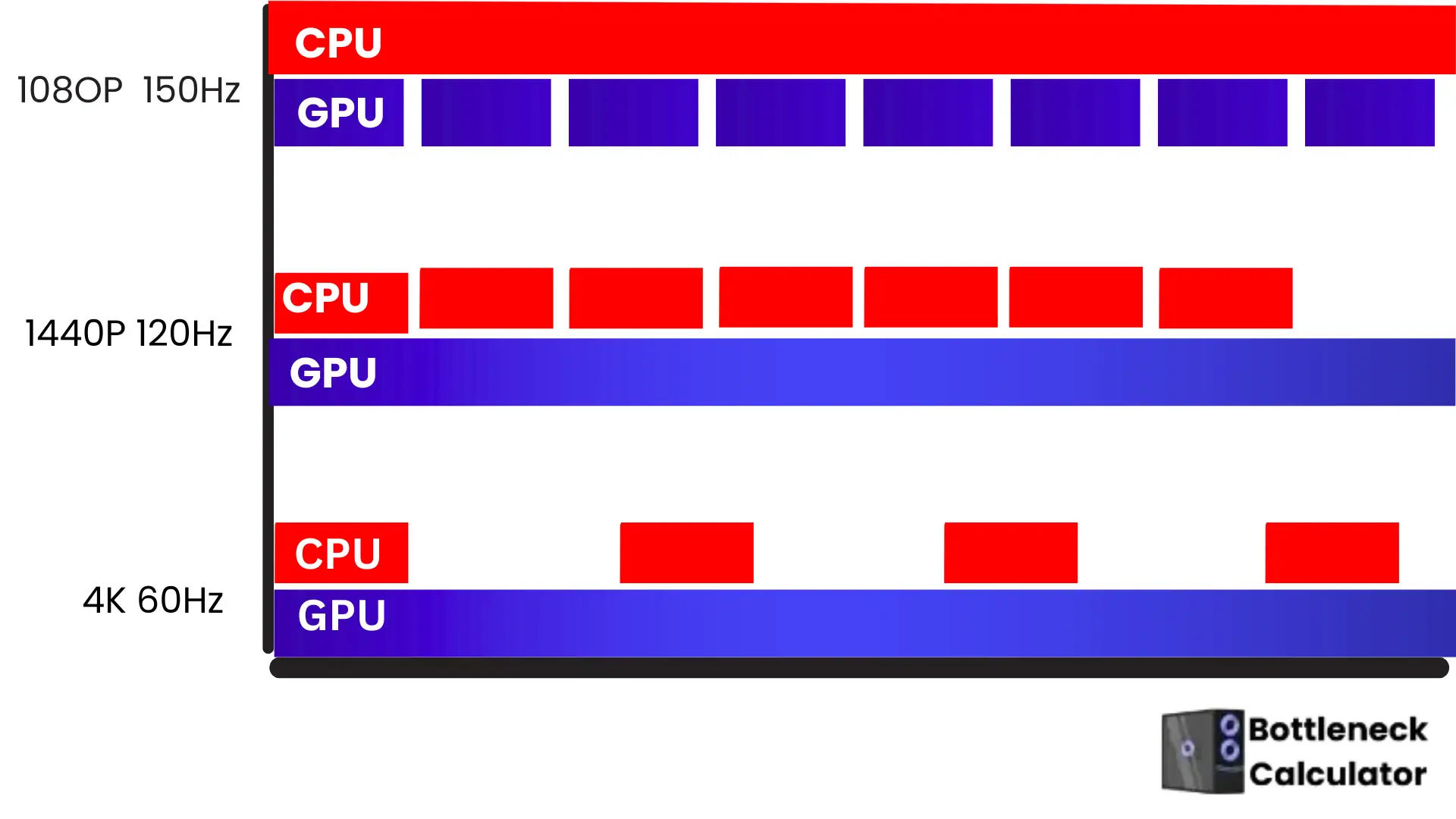
High resolutions increase the load on the GPU and also decrease the demand for the CPU. 1080P creates a bottleneck because the GPU works fast and requests data from the CPU. At 1440 p.m., the GPU works more, so the difficulty decreases the requirement on the CPU and transfers the bottleneck to the GPU.
Note: For more details, read our comprehensive guide on Multi-Monitor setup and make your resolution bottleneck-free.
The Balance Between CPU and GPU Combination
A balance between CPU and GPU is essential. A balanced system is one in which neither the CPU nor the GPU is over-stressed and delivers the best performance. Due to the properly managed system, computer components work for a long time and perform well.
An imbalance can move to under-utilization, where one component is overworked while the other component is underpowered. It slows down your computer system.

Why Can You Trust Our Bottleneck Calculator?
We regularly update our tool to deliver real-time and reliable data to users. PC calculator quickly checks the computer bottleneck and gives future suggestions to upgrade your performance without any hindrance.
FAQ’s
Conclusion
In this modern era, games and Software demand high performance and must be completely free from bottlenecks. Our trusted bottleneck calculator helps you detect the CPU and GPU bottleneck. Giving a clear screen of potential limitations.
In this article, we explained the PC bottleneck and the difference between CPU/GPU bottlenecks. I hope that by reading this article, you will easily identify and reduce the computer bottleneck.
By resolving these issues, your games run smoothly, the app opens fast, and your performance improves. If you have any problems using our bottleneck calculator, then you feel free to contact us.